The one nobody asked me to build
A catalog for twenty-four thousand sports cards across four players, designed and built by me for a hobby I got pulled back into during the pandemic. No client. No brief. No revenue. That’s sort of the point.
coquicardboard.com- Role
- All of it
- Scope
- Brand, product, front end, data
- Stack
- Next.js
- Scale
- 24,000+ cards cataloged
Let me be upfront about this one
Coqui Cardboard doesn’t make money. I’ve never posted about it anywhere. The people using it found it on their own, which is a generous way of saying there aren’t many of them.
I’m showing it to you anyway, because it’s the only thing here that nobody hired me to make. No client, no founder, no business case, nobody to talk me out of anything. If you want to know what my taste actually looks like when it isn’t in service of somebody else’s problem, this is the one.
Why nineties cards
I collected as a kid, then quit the way everybody quits, and then the pandemic happened, the whole hobby went vertical, and I got dragged back in. What got me wasn’t really nostalgia. It was the printing.
The nineties were when card companies stopped thinking of a card as a picture on cardboard and started treating it as a manufacturing problem. Refractors. Foil stamping. Die cuts. Holographic stock. Chromium. Embossing. They were competing on production technique, throwing everything at the wall to see what people would chase, and a lot of what they tried never got made again. Open a 1993 insert set and you’re basically looking at a catalog of print finishes that stopped existing.
Then go try to look one of those cards up. Almost every site that indexes them hands you a spreadsheet. Rows. Text. Maybe a thumbnail the size of a stamp.
The whole premise
These things are gorgeous objects and we look at them in tables.
So that was the whole premise. Build the place where they look like what they are.
Four vaults, four reasons
The players aren’t a market decision. They’re just mine.
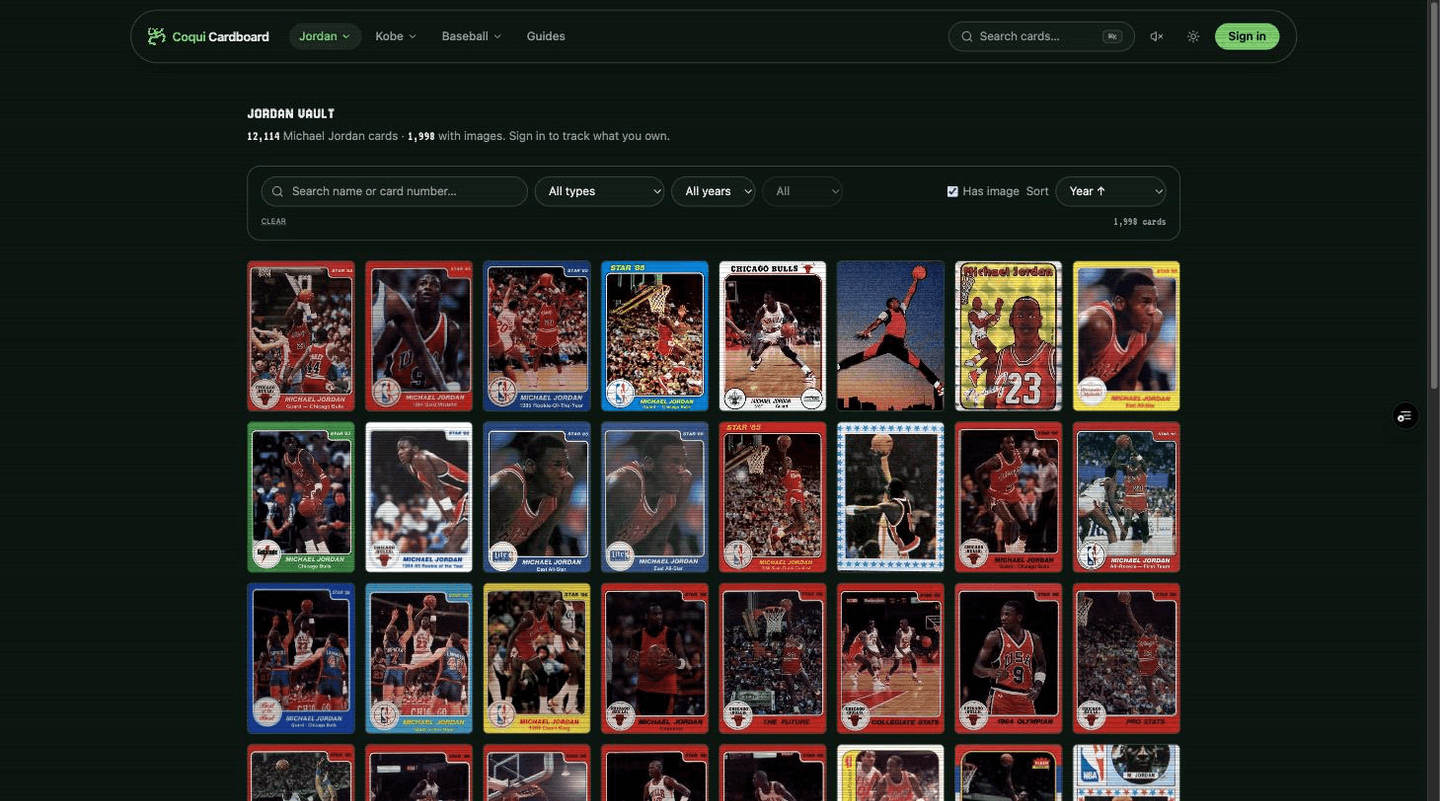
12,000+ cards, every issue
The reason I started collecting at all, and still the deepest catalog anyone has.
11,800+ cards, 1996 to now
The other one. His rookie year alone runs 143 cards across 25 different brands, which tells you everything about how that decade operated.
256 cards, complete playing-era run
Best Puerto Rican ballplayer who ever lived. My wife is Puerto Rican, and the coquí in the logo is as much hers as mine.
252 cards, complete playing-era run
From Payette, Idaho, which is where I’m from. He’s also a relative.
You can’t fake this kind of specificity with research. The Clemente and Killebrew vaults exist because of a marriage and a hometown, and they’re the two runs on the site cataloged completely, start to finish, because that’s what you do when you actually care about something.
Two ways in
There are two different structures sitting on the same cards, and they’re for two different moods.
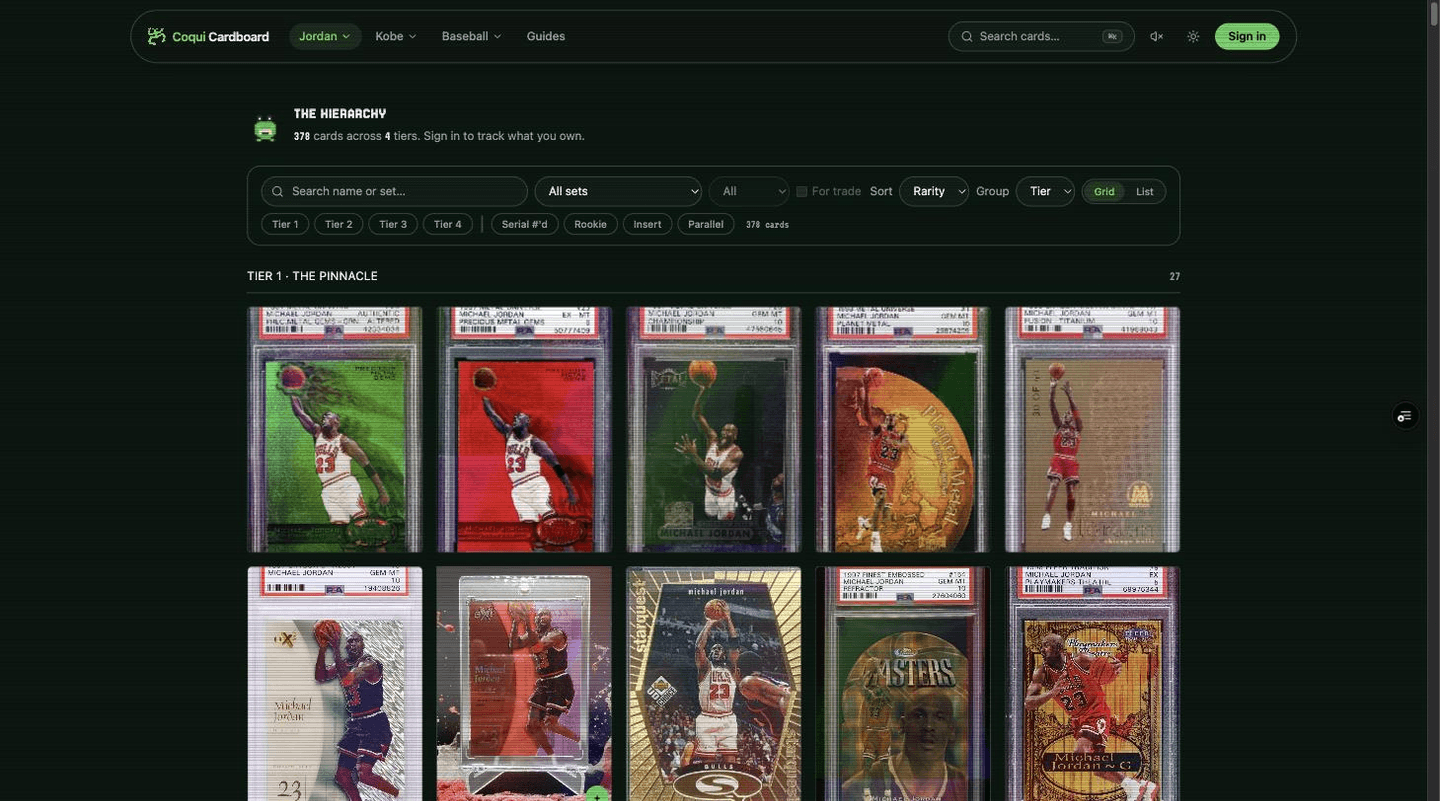
A Hierarchy is an opinion. The MJ Hierarchy is 378 cards sorted into four rarity tiers. The Mamba Hierarchy sorts 76 Kobe cards into grails, elite, and foundation. Somebody sat down and decided which cards matter and in what order. That somebody wasn’t me. The taxonomy comes from Cajun Cardboard, and they’re credited on the site. I didn’t write the canon. I built a good place to walk through it.
A Vault is the opposite of an opinion. Every card that exists for a player, searchable, ranked by nothing. Twelve thousand Jordans just sitting there waiting for you to find the one you’re after.
Somebody browsing to learn what’s significant and somebody hunting a specific parallel are in completely different headspaces.
Putting both of those in one product was the actual design call. If you make either one use the other’s interface, you’ve made the site worse for both of them. So the nav splits by player, and every player gives you both doors.
The look is the argument
If I’m going to claim these cards deserve better than a spreadsheet, the site has to actually be better, or I’m just complaining.
So: near-black background with a soft green glow, so scans read like objects under glass instead of thumbnails in a grid. Pixel type for the headings, clean sans for anything you have to read for more than a second. The mark is a pixel-art coquí, the tree frog you hear all night in . And there’s sound, which almost nothing on the web bothers with anymore, and which every card shop and arcade I ever stood in had running constantly.
None of that is decoration. It’s an argument that this hobby has a specific look, that the look belongs to a specific decade, and that a catalog is allowed to have a point of view instead of being neutral about everything.
Underneath the aesthetic there’s a real tool. You can track what you own and watch each tier’s completion percentage fill in. Log raw or graded copies with PSA, BGS, and SGC cert numbers. See eBay-sourced values over time instead of somebody’s guess. Build want lists for the cards you’re chasing. Share a public profile of your collection. There’s a command palette in the nav for people who come back often enough to already know what they’re looking for.
The parts that were hard
Getting the data. Nobody publishes a clean feed of twelve thousand Michael Jordan cards. I built a scraper to pull card information and images, and writing the scraper wasn’t the hard part. Doing it for an amount of money a personal project can absorb was the hard part, and that constraint ended up shaping more of the architecture than any design decision I made.
Finding the look. I went through a pile of iterations before I landed on something I’d defend. The early ones were more conventionally modern and had no particular reason to exist. The nineties direction was not obvious at the start.
What it was part of
Coqui was the last of four sites I designed and built in my spare time over a few months, while running my studio and doing the actual day job of designing CurbNTurf.
- 01The Tink TankMy studio. Brand and site.
- 02StickyFlowBrand and site for my AI systems company.
- 03CurbNTurf v2Full product redesign. The most ambitious of the four.
- 04Coqui CardboardThis one.
Four sites, all my design, all my code. Three are live, and CurbNTurf v2 goes public in mid-November 2026. I bring it up because the useful fact isn’t any single one of them. It’s that a designer who builds doesn’t have to wait on anybody to find out whether an idea works.